We’d been thinking about Hybrids for about three years. Not seriously at first. More out of frustration at overnight stops when traveling far and wide. After skipping our final night stop on a trip and plowing on home simply to avoid the 1 night setup, it felt like the signs were there to upgrade.
This article won’t be about what’s the best hybrid camper. It’s more of a hybrid camper buying guide detailing how we came to settle on the Hybrid we have now. Hopefully a few of my thoughts and decisions along the way assist your own process.
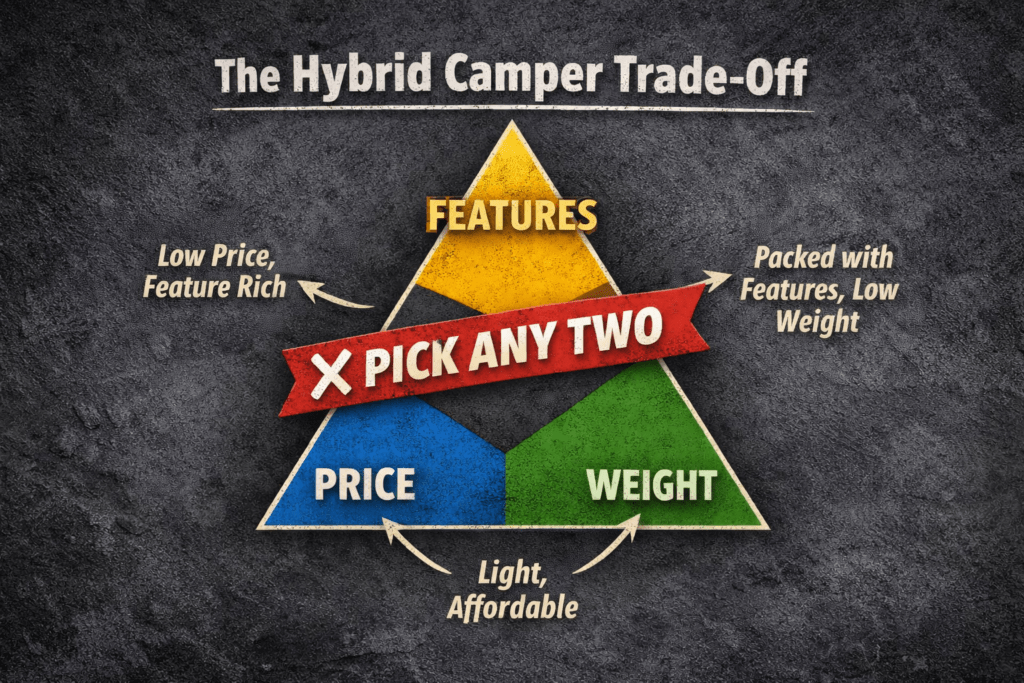
Exactly what type of upgrade we’d get bounced around my head many times. Forward fold, dual fold, Hybrid? Since my primary concern was ease of setup/packup, I always came back to Hybrids. Had I gone for a dual fold or similar, I think I’d be right back here in a years time. Immediately clear to me was that there was a balancing act to be had between price, weight, and features. You just can’t win on all three.
What I Thought I Wanted at the Start
Initially, my thought was we need the lightest hybrid that can sleep 2 adults and 3 kids. Not much else entered the equation. The GU Patrol had a towing capacity of 2.5t. We were coming from the soft floor camper, so the ability to setup and pack down quick was all I desired. I wasn’t chasing luxury in any sense. Even so, the options under 2.5 ton (fully loaded) are very limited!
I did have my eyes on the Mars Ranger X Deluxe, which has an ATM of 2.5 ton. So the GU could tow it. However, I was well aware of the GU’s struggles in towing the soft floor camper. A towing vehicle upgrade was inevitable, and something I thought I would do post upgrade. Even with that in mind, I still held the belief that at its most basic, we really just needed a place to sleep and cook that was quick to set up.
Almost Buying a 13ft Hybrid (And Why We Didn’t)
At one point, we were very close to pulling the trigger on a second hand 13-foot hybrid (with an ensuite even!)
The model was a Long Haul Camper T-Rex 13. The van looked the goods. Lithium setup, short enough to fit in our driveway, and a nice wide bottom bunk which the twins could share. I figured if the kids fought over space, I’d sleep in the swag (nice and peaceful!). At some point I’m sure they’re going to want to swag it for their own space too.
The main hesitation came from the van being in Queensland, and us being in South Australia. I thought I would drive up and tow it back empty with the GU – but even empty it’d be close to the GU’s limits, and it definitely wouldn’t appreciate any hills it had to climb! I started looking for a new tow vehicle in Queensland too, so I could kill two birds with one stone. But, in the meantime, that particular Hybrid sold.
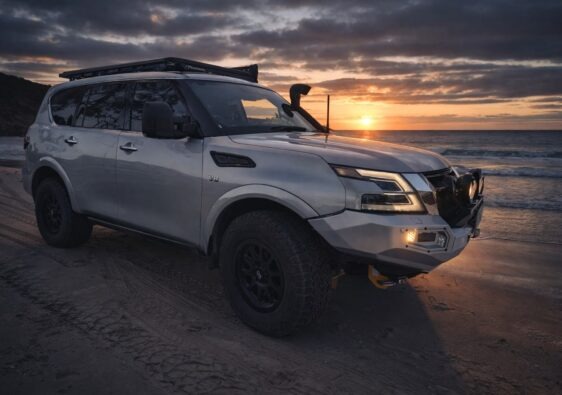
So, my focus changed to getting a new tow vehicle, so I’d be better prepared. We ended up with the Y62 Patrol. See why we came to that choice here.
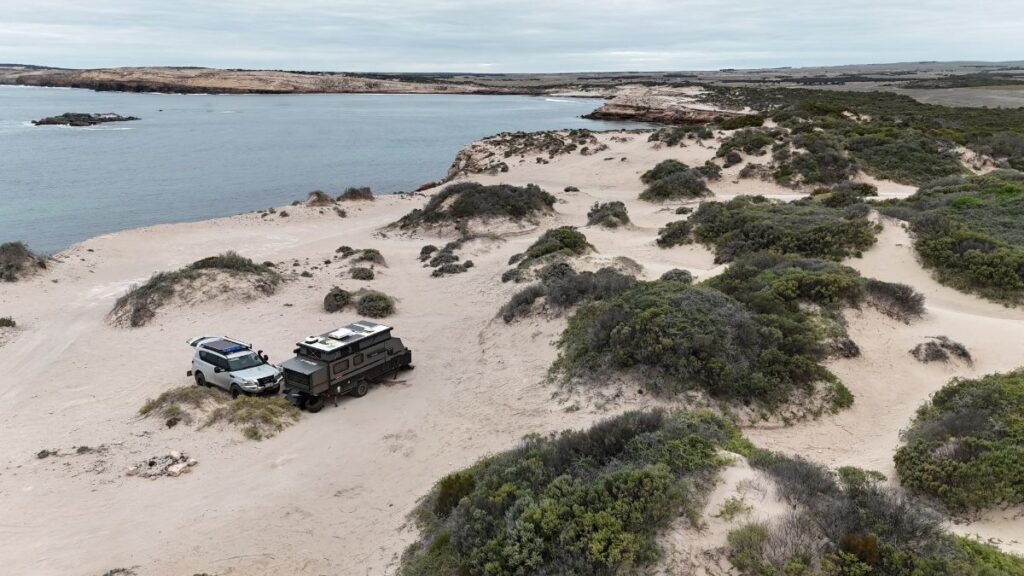
Towing Shape Still Matters (Even With a Big Tow Rig)
Even with the Y62 and its large towing capacity opening up options, I still had my focus on:
- Low Overall height (pop-top was a certainty)
- Body width – for getting down skinny tracks
- Track width for off-road towing
- Travel Length – both for ease of towing, and actually fitting in my driveway.
Given how long I bounced ideas around my head – at some point I concluded that the really tricky off-roading probably only happens on fishing trips with mates, where it’ll be swags-only anyway. With the family on board, and towing a 3 ton hybrid behind us, we’re unlikely to be doing anything too extreme.
The van needs to handle off-road, off-grid travel, but not extreme tracks. My focus shifted a bit to allow wider, higher models. A bit more comfort over off-road chops.
Off-Grid Capability Was Non-Negotiable
But one thing hasn’t changed. I have a strong aversion to caravan parks. The ridiculous costs. The overcrowding. The limited space you’re given. Get me away from them!
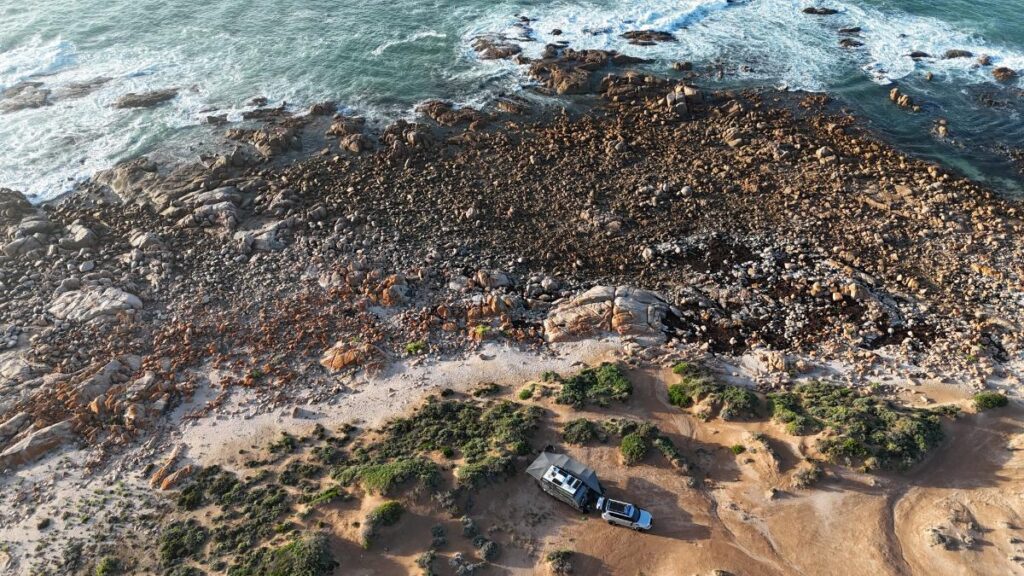
That made a solid lithium setup essential. I don’t think we’re huge power users. A few LEDs and the fridge really. 200ah would probably sufficient, given we have 200ah in the car too. But, the more the merrier when it comes to amp hours! Still, when it comes to Lithium, and keeping my beer cold, I don’t like to cut corners. The preference here was to have some quality components, and avoid the cheaper end of the market.
Similarly, a wrap-around awning was high on my list of preferences. If a van didn’t come with one, I could already see myself upgrading later, which isn’t a cheap exercise. I just really like the 270 awnings I’ve seen on some demo vans. Any vans that had it installed already were high on my list.
Why an Ensuite Slowly Became Important
Originally, I wasn’t chasing an en-suite at all, but the T-Rex I looked at opened my mind to it a bit. We’ve always camped rough. Tents, swags, showers in a bucket (or not at all!), taking a long walk with a shovel to visit nature. That kind of thing. The kids hadn’t experienced it any other way. They commented on friends having a TV in their caravan, and I’ve convinced them they’re not really camping if they’re watching TV. It’s working, so far!
But, traveling through Tasmania, I started noticing more areas shifting toward “fully self-contained only” access. Basically, you aren’t allowed in unless you’re catching your grey water and having a chemical toilet on board. Western Australia, high on our future destination list, appears to be heading the same way. Coming from South Australia it’s funny to think of taking grey water with you. Most places are desperate for any water to be thrown around the trees!
But I get it. Environmental pressure, overuse, and poor behaviour have consequences. Old style camping is unfortunately being lost to us, and we move with the times.
I won’t ignore the obvious benefits too. I have three young girls. Night time toilet visits will be a breeze. Having a shower on board to rinse off the salt and sand at the end of the day will be great. And of course, We’ll get into places we otherwise might not. I guess the opposite is true in that towing a van will prevent access to other types of places – but as a family of five we won’t fit our gear without towing something!
A Bigger Tow Vehicle Doesn’t Remove All Constraints
The Y62 opened up a lot more options. I could now easily tow 3 ton, but it didn’t remove every limitation.
There was still the constraint of where we’ll actually store this thing too. I want it at home for ease of use and avoiding storage expenses. Initially, I focused on hybrids around 13 feet, roughly 6 metres total length, because I assumed that was my absolute maximum.
Then one day, I rolled the soft floor camper out and physically positioned it in different spots along the driveway. At around 6.8 metres, I realised I could probably just squeeze past. That small discovery massively widened the field. 15 foot vans were now in play.
Accepting That (Slightly) Bigger Might Actually Be Better
The more I thought about it, the more I came to accept that for a family of five, a 15-foot hybrid simply makes more sense.
We’ll do our living outside, we’ll cook outside. But a little extra space to accommodate the growing girls will see the van last us longer. It’ll provide some comfort when the weather turns bad.
15 foot models also brought in the option of internal cooking. Now, I hope that I never have to use this. But another point of acceptance was: at some point, its going to be raining sideways, or sand blowing everywhere and having the option available is just nice thing to have.
Why not a Triple Bunk?
Quite simply, 15-foot hybrids with three proper bunks are rare. You can get extra bunks installed, but you’ve giving something up elsewhere in doing so. My preference was the double sized bottom bunk. The twins could share for a period of time, or if they’re really arguing (not uncommon) then one of us parents can swap in.
Why Buying New Was Never an Option
New hybrid prices over the last few years have gone wild.
What used to feel like a stretch now feels unjustifiable. For us, used or near-new was the only sensible path. Better value, slower depreciation, and hopefully already fitted with the upgrades we’d add anyway. In the end, we paid more than I anticipated, but it was still far less than buying new, and it ticked all the boxes (much like my Y62 buying experience!)
The Core Lesson: Price, Weight, Features
Every decision came back to the same triangle:
- Price
- Weight
- Features
You can usually choose two.
Add features → weight goes up
Reduce weight → price goes up
Lower price → features and quality reduce
There is the factor of Chinese made vs Australian made. I’d originally thought “of course Australian made!” … and then I saw the prices. I simply would not have a Hybrid Camper if I limited myself to Australian Made. There’s so many Chinese made vans on the road these days, I suspect (and rely on) the assumption that quality is getting much better. Once some key components like suspension, bearings and tyres are upgraded, I feel like we’re in a sweet spot of price and quality.
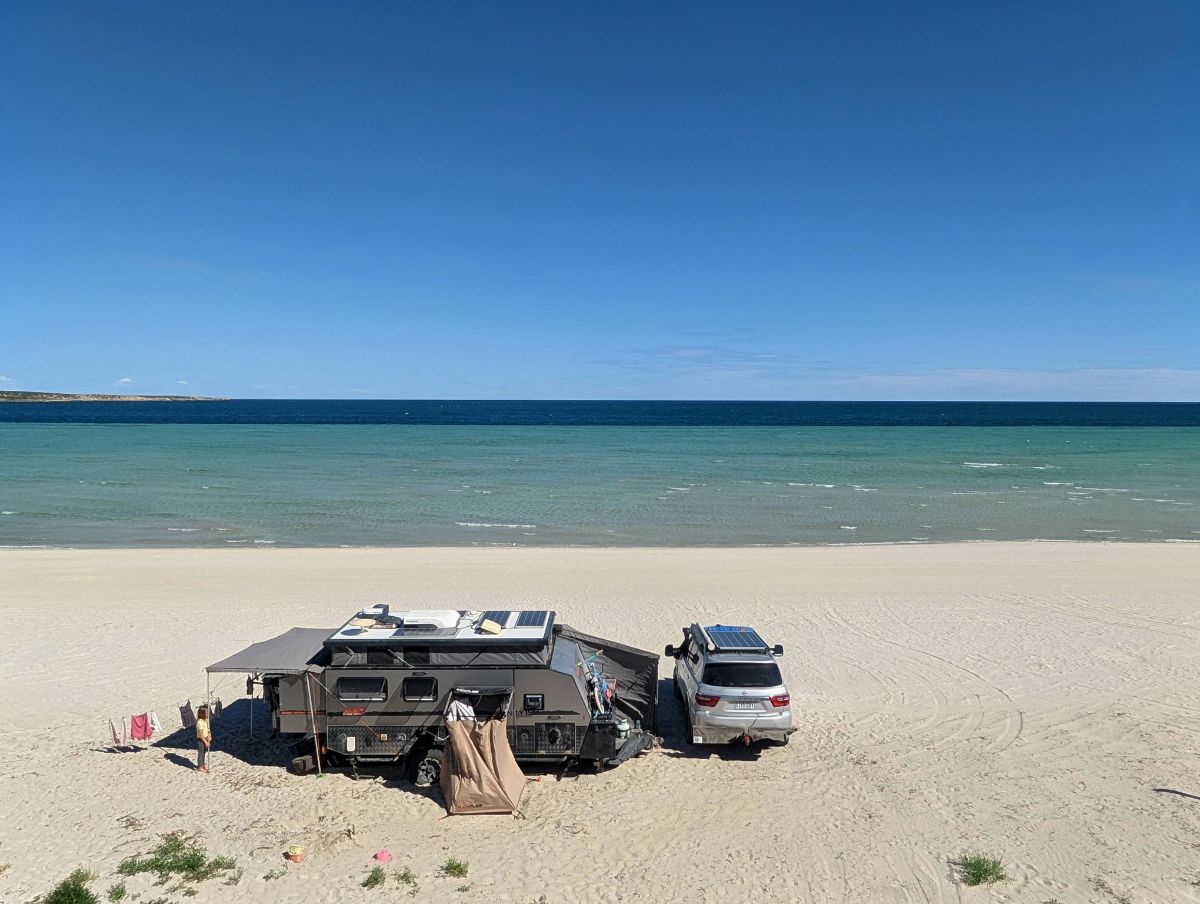
The Decision: 2021 Jawa Infinity 15
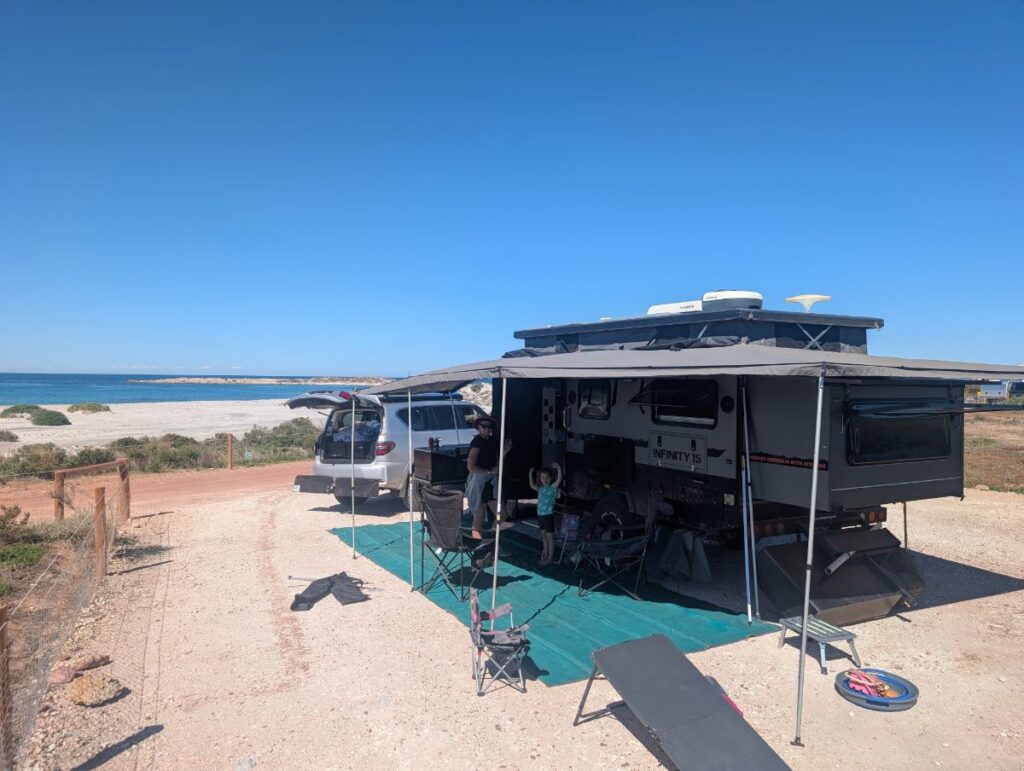
My saved van list on Marketplace was getting pretty large when I saw this van come up. This one caught my eye because of the wrap around awning, and big bunks. At first I was put off by the width (it goes around 2.36m) and a seemingly low payload (around 550kg) compared to some other vans. But as mentioned above, I started to compromise on size/width.
It has: The widest bottom bunk I’m aware of at 1200mm wide! That’s a proper double bed. It’s got the en suite with gas hot water, internal sink & cooktop. The previous owners have installed a 130l internal fridge in addition to the (included in sale) 95l Dual Zone Waeco outside. I’m undecided if we need the internal fridge and it may make room for more clothes storage. We’ll see how I feel after a few trips.
Jawa has a decent reputation for taking Chinese builds and fitting them out with good parts. This van is no exception with Lovells suspension upgrades, Japanese bearings, and quality tyres (basically new Toyo’s). It came with a Generator too, but there’s a 340ah Giant Lithium with Enerdrive charger onboard so I’m not sure I’ll need it. There should be plenty of battery for us to stay off grid until we run out of water! Speaking of water – the Jawa Infinity 15 can hold 240 litres, plus it has an 80 litre grey water catchment tank.
I’m not actually sure how much solar is on the roof. The seller said it was 600w, but I think it is actually 400w (there are 4 not huge panels). The most I’ve seen going in is 280w, but given they’re flat and not pointed at the sun, that seems about right for 400w. I’ll probably get a portable foldout panel just in case.
The wraparound awning includes all walls to enclose in when the weather goes bad. A custom storage box on the back instead of a second spare is welcome.
Is it the perfect van? No – its heavy and the payload isn’t best in class. But the sooner you accept that no van is, the sooner you can find the van that suits your needs as best as possible.